Loading demo…
Document understandingComing Soon
Document AI — structured data extraction
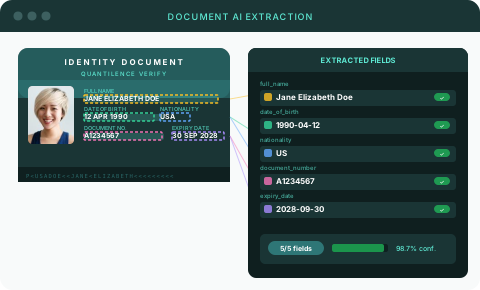
Send any document — invoice, contract, ID card, or form — and get back structured JSON with labelled fields. No template configuration, no pre-training. Works out of the box.
- 98.3% field-level accuracy
- ~350ms median latency
- Invoices, IDs, contracts, forms
- Zero-shot — no template setup required
Availability
Document AI is in private beta
Extraction quality depends entirely on the document families you process, so a generic sample uploader would tell you very little. Early access runs against your own corpus with engineering support.
No public demo yet
We run early access as a design-partner programme — you get API keys and we get feedback from a real integration before general release.
How it works
How document extraction works
The hard part was never reading the characters. It is knowing that the number in the bottom-right corner is the total and the one beside it is the tax — on a layout nobody configured in advance.
- 1
The document is read
Text and layout are recovered first — words, their positions, and the visual structure holding them together. This is the OCR layer doing its job.
- 2
Layout becomes meaning
The model interprets structure the way a reader does: this string sits under a heading, that one is right-aligned next to a label, this block is a table of line items.
- 3
Fields are labelled
Values are assigned semantic names — invoice_number, due_date, total_amount, line_items — inferred from context rather than looked up in a per-layout template.
- 4
JSON comes back with confidence
You get named fields with a confidence score on each, so your pipeline can auto-accept the certain ones and escalate only what genuinely needs a human.
Approach
Template-based vs zero-shot extraction
Traditional document processing means drawing boxes on a sample and telling the system what lives where. That works until the eleventh supplier sends a different layout.
| Template-based | Zero-shot | |
|---|---|---|
| New supplier layout | Build and test a template first | Works on the first call |
| Layout changes | Template breaks silently | Adapts — context, not coordinates |
| Setup time | Days to weeks per document type | None |
| Long-tail documents | Uneconomic to template | Handled like any other |
| Maintenance | Grows with every layout added | Flat |
Output
What you get back
Named fields with per-field confidence, plus the source position of each value so you can show a reviewer exactly where a number came from.
Labelled fields
Semantic names rather than coordinates — invoice_number, due_date, total_amount — typed and normalised where the format is unambiguous.
Per-field confidence
A score on every extracted value, so auto-accept and escalate become a threshold decision rather than an all-or-nothing one.
Source positions
The region each value came from, so a review UI can highlight the original text instead of asking someone to hunt for it.
If you need positioned text rather than labelled fields, that is OCR. If you need to know what kind of document arrived before deciding how to parse it, chain document classification in front.
Use cases
What teams use Document AI for
Accounts payable
Pull totals, tax, dates, and line items from supplier invoices arriving in every layout imaginable, without a template per vendor.
KYC document intake
Read name, date of birth, document number, and expiry from identity documents, then pair with a face check on the portrait.
Lending and underwriting
Extract figures from bank statements and payslips so assessment starts from structured data instead of PDFs.
Contract review
Surface parties, dates, renewal terms, and values across an agreement archive that was never structured to begin with.
In KYC specifically, document extraction pairs with a biometric check on the portrait — face comparison is live today and handles that half.
FAQ
Document AI FAQ
- What is Document AI?
- Document AI turns a document into structured data with labelled fields — it does not just read the text, it works out what each piece of text means. Sending an invoice returns an invoice number, a total, a due date, and line items as named JSON fields rather than a transcript.
- How is it different from OCR?
- OCR tells you what characters are on the page and where they sit. Document AI tells you what they represent. OCR gives you the string "£1,240.00" at some coordinates; Document AI gives you total_amount = 1240.00. Document AI uses OCR underneath and adds the interpretation layer on top.
- What does zero-shot mean here?
- You do not build a template per layout or train the model on your supplier set before it works. The model reads the document the way a person would — using labels, position, and context — so a supplier invoice it has never seen parses on the first call. This is the difference between a two-week onboarding per vendor and none.
- Which document types does it handle?
- Invoices, receipts, contracts, identity documents, bank statements, utility bills, and general forms. Because extraction is zero-shot rather than template-driven, unusual layouts within those families are handled without special configuration.
- What does 98.3% field-level accuracy mean?
- It measures whole extracted fields that are exactly right, not individual characters. That is a stricter and more useful measure than character accuracy — a date is either correct or it is not. It also means roughly one field in sixty needs review, so consequential values deserve validation rather than blind trust.
- Does it return confidence scores?
- Yes, per field. The practical pattern is to auto-accept high-confidence fields and route the rest to a human, which concentrates review effort on the small share of values that actually need it instead of re-checking everything.
- Can it handle multi-page documents?
- Yes. Fields that span pages — a contract clause, a statement running across several sheets — are resolved against the whole document rather than page by page.
- When will the API be available?
- Document AI is in private beta. Extraction quality depends heavily on the document families you actually process, so early access pairs API keys with tuning against your own corpus. Contact us to be considered.
Related: OCR, document classification, and everything that is live today.
Ready to ship identity verification?
Talk to our engineering team about your use case. We'll get you up and running in under a day.
SOC 2 Type II · GDPR Ready · ISO 27001