Loading demo…
1:1 biometric matchingLive
Compare two faces online — free
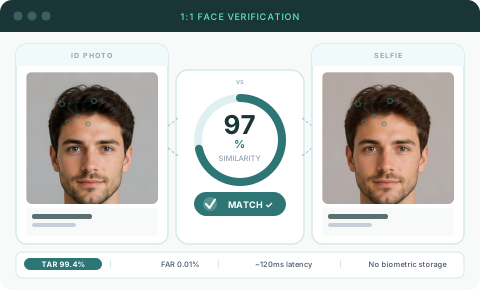
Upload two face photos and get an AI similarity score with a match/no-match verdict in milliseconds. No account, no credit card. The same model runs in production for KYC, re-verification, and onboarding flows.
- 99.4% TAR at FAR 0.01%
- ~120ms median latency
- Match / No-match verdict with confidence score
- Works with selfies, ID crops, and live captures
Live demo
Free face comparison tool
Upload two face photos to compare them and get a similarity score with a match verdict.
Image 1
Image 2
Comparisons
Upload two photos and click compare
How it works
How face comparison works
Face comparison doesn't match pixels. It converts each face into a numeric fingerprint of identity, then measures the distance between the two. That's why it still works when the photos were taken years apart, in different lighting, with a different haircut.
- 1
Upload two face photos
Add an image to each slot — a selfie, a cropped ID portrait, or a passport-style photo. Only the face region matters, so a full-frame photo is fine as long as the face is clearly visible.
- 2
The model detects and aligns each face
A detector locates the face and its landmarks, then warps it to a canonical pose. This alignment step is what lets the comparison tolerate differences in head angle, distance, and crop.
- 3
Each face becomes an embedding
The aligned face is passed through a recognition network that outputs a 512-dimension vector. The vector encodes identity — bone structure, feature spacing — rather than hairstyle, expression, or lighting.
- 4
You get a score and a verdict
The cosine distance between the two vectors is mapped onto a 0–100 similarity score and thresholded into a match or no-match verdict, returned with a confidence value in roughly 120ms.
Interpreting results
What the similarity score means
The score runs from 0 to 100. It is not a probability that the two people are the same — it's a calibrated distance between the two face embeddings. Here's how to read it.
| Score | Verdict | What it means |
|---|---|---|
| 85–100 | Strong match | Same person, good quality images on both sides. Safe to auto-approve in most onboarding flows. |
| 70–85 | Match | Same person, but one image is degraded — a printed ID scan, an off-angle capture, or poor lighting. |
| 40–70 | Inconclusive | Genuinely ambiguous. Route to manual review rather than deciding automatically. Often caused by heavy occlusion or a large age gap. |
| 0–40 | No match | Different people. Scores in this band are reliable — false rejections here are rare with usable input images. |
The default threshold sits at 70, tuned for 0.01% FAR — fewer than one false match in ten thousand comparisons. Raise it if a wrong approval is expensive; lower it if you would rather send borderline cases to a human than reject a legitimate user. For the full picture on accuracy trade-offs, see understanding face recognition accuracy.
Image quality
Which photos work best
Most disappointing results come from the input, not the model. A borderline score usually means one of the two photos gave the detector very little to work with.
Works well
- Frontal or near-frontal pose, under about 30° of rotation
- Even lighting across the whole face
- Face occupying a reasonable share of the frame
- Eyes visible and unobstructed
- Sharp focus — no motion blur
Reduces accuracy
- Profile shots or head turns beyond 45°
- Sunglasses, masks, or hands covering features
- Harsh backlighting that silhouettes the face
- Faces smaller than roughly 80×80 pixels
- Heavy beauty filters or aggressive retouching
A large age gap between the two photos is the one factor you often can't control. Expect scores to drift down roughly as the gap widens past a decade — still usually above threshold for the same person, but with less headroom.
Use cases
What teams use face comparison for
KYC onboarding
Match a live selfie against the portrait on a government ID to confirm the person opening the account is the document holder.
Re-verification
Confirm a returning user is the same person who originally enrolled, before a password reset or a high-value transaction.
Duplicate account detection
Compare a new applicant against previously enrolled faces to catch one person registering under several identities.
Access control
Verify a badge photo against a live capture at a door or kiosk, without maintaining a separate biometric gallery.
Demo vs API
From free tool to production API
The demo above and the REST API run the same model on the same weights. The difference is throughput, guarantees, and paperwork.
| Free demo | API | |
|---|---|---|
| Model & accuracy | Identical | Identical |
| Access | Browser upload | REST, JSON in / JSON out |
| Input | Image files | Image URLs or base64 |
| Volume | A few comparisons | Rate limits by plan |
| Uptime SLA | Best effort | Contractual |
| DPA & compliance docs | Not applicable | Included on enterprise |
Handling face images in the EU brings Article 9 obligations with it — see GDPR and biometric data before you put this into a live onboarding flow.
FAQ
Face comparison FAQ
- Is the face comparison tool free?
- Yes. The live demo is completely free — no account, credit card, or signup required. Upload two photos and get instant results.
- How do I compare two faces online?
- Upload two photos using the demo above. The AI extracts facial embeddings from each image and computes a similarity score from 0 to 100, along with a match or no-match verdict. Results are returned in under 200ms.
- How accurate is the face similarity checker?
- Our face comparison model achieves 99.4% TAR (True Accept Rate) at 0.01% FAR (False Accept Rate) on the IJB-C benchmark — one of the most rigorous academic face verification datasets. Fewer than 1 in 10,000 comparisons produces a false match at the default threshold.
- What does the similarity score mean?
- The similarity score ranges from 0 to 100. Scores above 70 typically indicate the same person; scores below 40 indicate different people. Scores between 40 and 70 are borderline depending on image quality, pose, and lighting. A match/no-match verdict is returned alongside the score.
- What types of photos work best for face comparison?
- Clear, well-lit frontal face photos give the best results. The tool accepts selfies, ID document crops, and passport-style photos. Extreme angles above 45 degrees, heavy occlusion from masks or sunglasses, or very low resolution images may reduce accuracy.
- Can I compare a selfie against an ID document photo?
- Yes. Selfie-to-ID comparison is the most common production use of the API. Crop the portrait region from the document and upload it as the second image. Printed and scanned ID photos are lower quality than live captures, so expect scores a few points below a selfie-to-selfie comparison of the same person.
- Do you store the photos I upload?
- No. Demo images are processed in memory and discarded once the comparison returns. Nothing is written to disk or used for model training. See our security page for the full data handling policy.
- Can I use this as a facial comparison API?
- Yes. The same model powering this free demo is available via REST API for production use. The API accepts two image URLs or base64-encoded images and returns a similarity score, match verdict, and confidence value in JSON. Enterprise plans include SLAs and a Data Processing Agreement.
Related reading
Go deeper
How to compare two faces online
A step-by-step walkthrough of the comparison flow and how to read the result.
ReadBest free face comparison tools (2026)
How the free online face comparison tools actually differ, and which to use when.
ReadFace verification API vs traditional KYC
Where automated face matching replaces manual document review — and where it does not.
ReadRelated tools: face detection, liveness detection, and face blur.
Ready to ship identity verification?
Talk to our engineering team about your use case. We'll get you up and running in under a day.
SOC 2 Type II · GDPR Ready · ISO 27001