Loading demo…
Text extractionComing Soon
OCR API — extract text from any document
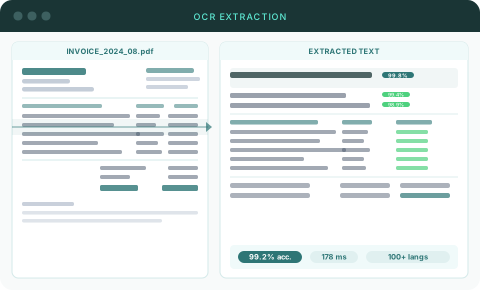
Extract printed and handwritten text from any image or document with sub-second latency. Bounding-box output, multi-language recognition, and structured table extraction — all in a single API call.
- 99.1% character-level accuracy
- ~200ms median latency
- Tables, key-value pairs, and raw text
- 50+ language support
Availability
OCR is in private beta
Text extraction is only as good as the documents you throw at it, so we are testing against real customer document sets rather than a public sample uploader. Early access includes API keys and help tuning for your layouts.
No public demo yet
We run early access as a design-partner programme — you get API keys and we get feedback from a real integration before general release.
How it works
How OCR works
Reading characters is the part everyone thinks about and the part that fails least often. Most OCR disappointment comes from geometry and layout — a skewed page or a table flattened into a paragraph.
- 1
The page is straightened
Skew, rotation, and perspective from a handheld photo are corrected first. Almost every downstream error traces back to geometry that was never fixed at this stage.
- 2
Text regions are located
The model finds where text sits on the page — lines, blocks, table cells, form fields — before trying to read any of it, which is what makes layout recovery possible later.
- 3
Characters are recognised
Each region is transcribed, with language detected automatically rather than declared up front, so mixed-script documents work in a single pass.
- 4
Structure is reassembled
Recognised text is put back into reading order with tables preserved as rows and columns and label-value layouts emitted as key-value pairs.
Output
What you get back
One call returns four views of the same page. Which one you use depends on whether you need the words, their positions, or their relationships.
| Output | Shape | What it is for |
|---|---|---|
| Raw text | string | Full-text search and indexing, where position does not matter. |
| Text blocks with boxes | [{ text, bbox, confidence }] | Redaction, highlighting, and mapping text back onto the rendered page. |
| Key-value pairs | [{ key, value }] | Forms and label-value layouts — invoice number, date, account holder. |
| Tables | [[cell, …], …] | Line items, statements, and anything that loses its meaning as flat text. |
If what you actually want is labelled fields — invoice total, due date, account holder — rather than positioned text, that is Document AI, which sits on top of this layer.
Input quality
Which scans work best
Reads reliably
- 300 DPI scans of printed documents
- Phone photos in focus and roughly square to the page
- Moderate skew — corrected automatically
- Mixed-language and mixed-script pages
- Neat handwriting in structured form fields
Reduces accuracy
- Motion blur and out-of-focus captures
- Heavy JPEG compression artefacts
- Low-contrast text — faded thermal receipts, carbon copies
- Free-flowing cursive handwriting
- Extreme perspective from a sharply angled photo
Use cases
What teams use OCR for
Document digitisation
Turn scanned archives into searchable text so records stop being images nobody can query.
Invoice and receipt processing
Pull line items and totals out of supplier documents that arrive as PDFs and phone photos.
Form intake
Read completed paper forms, including handwritten fields, without manual transcription.
Compliance and audit search
Make historical document sets searchable so retention and disclosure requests do not mean reading every page.
FAQ
OCR FAQ
- What is OCR?
- Optical character recognition converts text that exists as pixels in an image into text a program can read and search. It covers everything from a scanned contract to a photo of a receipt taken on a phone.
- Does it read handwriting?
- Yes, though handwriting is meaningfully harder than print and accuracy varies with legibility. Expect strong results on neat handwriting in structured fields such as forms, and lower confidence on free-flowing cursive.
- What does character-level accuracy mean?
- It measures the share of individual characters recognised correctly, which is not the same as the share of documents processed correctly. A 99.1% character accuracy on a 1,000-character page still averages around nine wrong characters, so field-level validation matters for anything consequential.
- Can it extract tables?
- Yes. Beyond raw text, the API returns structured table output preserving row and column relationships, plus key-value pairs for label-and-value layouts. Recovering that structure is usually the difference between usable output and a wall of text.
- How many languages are supported?
- Over 50, including non-Latin scripts. Mixed-language documents are handled in a single pass without you having to declare the language up front.
- What is the difference between OCR and Document AI?
- OCR tells you what text is on the page and where. Document AI tells you what that text means — that this string is the invoice total and that one is the due date. OCR is the layer underneath; if you need labelled fields rather than positioned text, Document AI is the right product.
- What image quality does it need?
- Roughly 300 DPI for scans, or a phone photo where the text is in focus and reasonably square to the camera. Skew is corrected automatically within moderate angles. Motion blur and heavy JPEG compression hurt more than resolution alone.
- When will the API be available?
- OCR is in private beta. Early access includes API keys and direct engineering support in exchange for feedback on real document sets. Contact us to be considered.
Related: Document AI, document classification, and everything that is live today.
Ready to ship identity verification?
Talk to our engineering team about your use case. We'll get you up and running in under a day.
SOC 2 Type II · GDPR Ready · ISO 27001