Loading demo…
Privacy & anonymizationLive
Blur faces in photos online — free
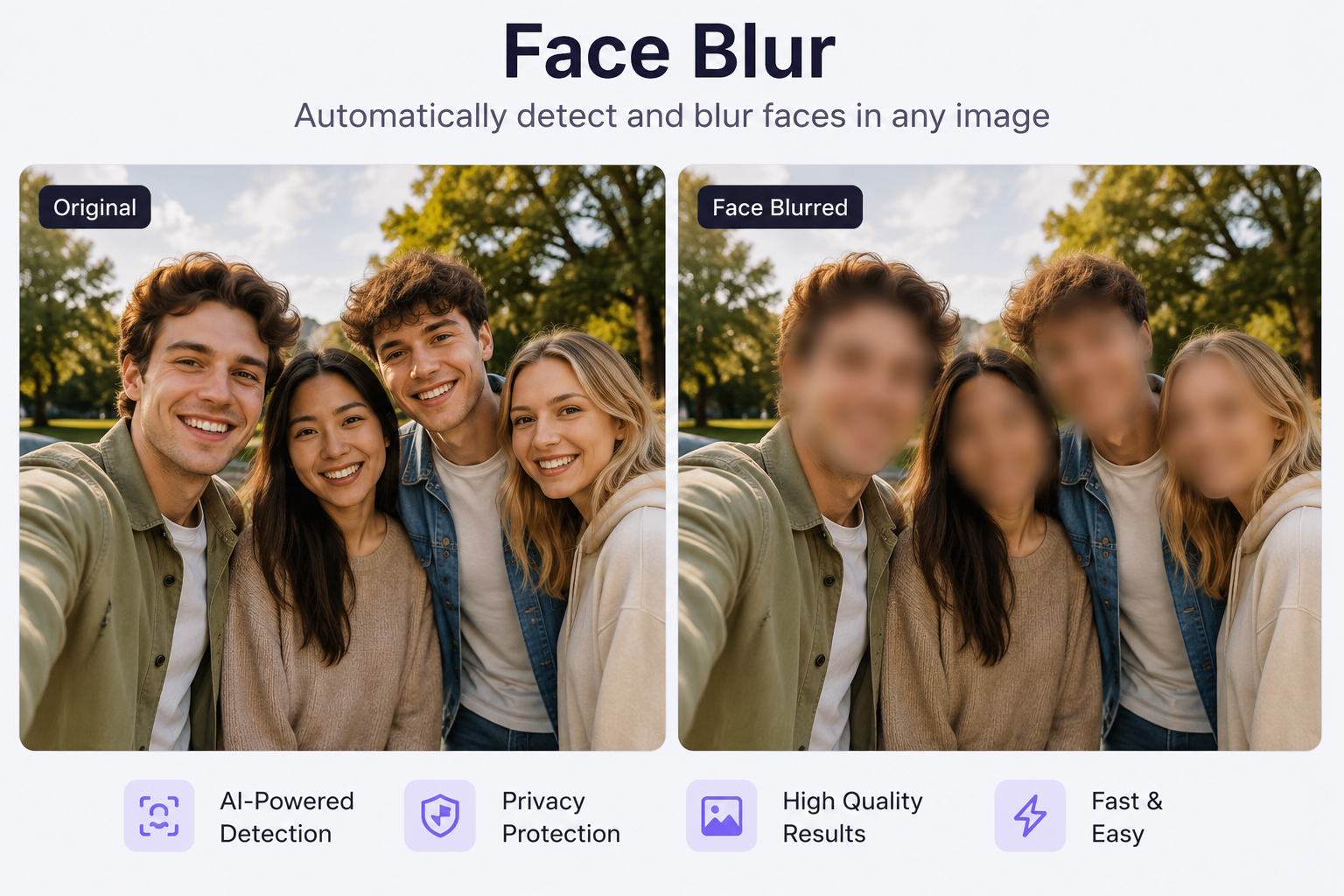
Upload any image and the AI finds every face and blurs it using elliptical Gaussian masking. No account, no manual selection. Built for privacy compliance, media redaction, and dataset pipelines.
- 99.6% face detection rate
- ~90ms median latency
- Elliptical Gaussian masking
- Multi-face and crowd images supported
Live demo
Free face blur tool
Upload a photo to automatically detect and blur all faces. Download the anonymized result.
Input image
Result
Upload an image to blur faces
How it works
How automatic face blurring works
Manual redaction is where most privacy mistakes happen — someone blurs the two obvious faces and misses the four in the background. Automatic blurring removes that step entirely: detection and masking run in one pass over the whole frame.
- 1
Upload the photo
Drop in any image with faces in it — a group shot, a street scene, a CCTV still, a screenshot. You do not select or brush over the faces yourself; that is the point of the tool.
- 2
Every face is detected
A detector sweeps the whole frame and returns a region for each face it finds, down to small background faces most people would miss when redacting by hand.
- 3
Each region is masked
An elliptical Gaussian mask is applied per face rather than a rectangle, so the redaction follows the shape of the head instead of blocking out surrounding context.
- 4
Download the anonymized image
The result comes back as a JPEG along with a count of how many faces were blurred, so you can sanity-check the output before publishing it.
Privacy
Blurring is not the same as anonymization
Worth being precise about, because the two get used interchangeably and the difference has legal consequences. Blur obscures a face; anonymization means the person can no longer be identified at all. Those are different bars.
Gaussian blur
Softens the face pixels while keeping head shape and position visible. Fast, familiar, and appropriate when the goal is optical privacy — press photos, social posts, screenshots.
Can sometimes be reversed on high-resolution sources with neural upscaling.
Solid-fill masking
Replaces the face region with a solid colour or noise, discarding the underlying pixel information entirely. The right choice when you need the redaction to be irreversible.
Visually heavier — obviously redacted rather than subtly obscured.
Face replacement
Swaps in a synthetic face that preserves head pose and expression but belongs to nobody. Useful for training datasets where you need natural-looking faces without real identities.
Highest processing cost of the three.
Under GDPR Recital 26, data stops being personal data only when the subject is no longer identifiable — and Gaussian blur on a high-resolution source can sometimes be undone. If you are blurring to meet a legal obligation rather than to be polite to bystanders, read face blur vs anonymisation and GDPR and biometric data before deciding blur is sufficient.
Image quality
Which images work best
A missed face is worse than a bad blur, so it is worth knowing where detection gets harder. Always check the reported face count against what you can see in the frame.
Detects reliably
- Faces reasonably sized in frame — roughly 40×40 pixels or larger
- Frontal and three-quarter views
- Ordinary lighting, indoor or outdoor
- Crowd and group shots with many faces
- Standard JPEG, PNG, or WebP input
Worth double-checking
- Very small or distant faces in wide landscape shots
- Faces mostly hidden behind objects or other people
- Extreme motion blur in the source image
- Back-of-head or full profile views the detector may not classify as faces
- Heavily stylised illustrations rather than photographs
Use cases
What teams use face blur for
Publishing and press
Redact bystanders in news photography, documentary stills, and social posts before publication, without hand-masking every face.
Dataset preparation
Strip identifiable faces from image sets before they go into training or analytics pipelines, keeping the surrounding scene intact.
CCTV and security footage
Anonymize uninvolved people in footage shared with third parties, insurers, or during an investigation handover.
Internal screenshots and docs
Blur customer or employee faces in support tickets, bug reports, and product screenshots before they circulate more widely.
Demo vs API
From free tool to production API
One-off redaction belongs in the browser. Anonymizing ten thousand images belongs in a pipeline — same model, called over REST.
| Free demo | API | |
|---|---|---|
| Model & detection rate | Identical | Identical |
| Access | Browser upload | REST, multipart in / image out |
| Output | JPEG download | Blurred image plus face count |
| Volume | A few images | Rate limits by plan |
| Batch processing | One at a time | Pipeline-friendly |
| DPA & compliance docs | Not applicable | Included on enterprise |
FAQ
Face blur FAQ
- Is the face blur tool free?
- Yes. The live demo is completely free — no account, credit card, or signup required. Upload a photo, blur every face, and download the result.
- How do I blur faces in a photo online?
- Upload an image using the demo above. The detector finds every face in the frame, applies an elliptical Gaussian mask to each one, and returns the anonymized image for download. No manual selection or brushing is needed.
- Does it blur every face automatically?
- Yes. Detection and blurring happen in the same pass, so crowd scenes, group photos, and street photography are handled without picking faces by hand. The demo reports how many faces it found so you can confirm nothing was missed.
- Can the blur be reversed?
- Gaussian blur is not mathematically irreversible. With a high-resolution source image, modern neural upscalers can sometimes recover enough detail to enable re-identification. For publication and content moderation this is rarely a concern, but it matters if you are relying on blurring as a legal anonymization measure.
- Is blurring faces enough for GDPR compliance?
- Not by itself. Under GDPR Recital 26, data is anonymized only when the subject is no longer identifiable at all. Because blur can sometimes be reversed on high-resolution sources, blurred images may still count as personal data. Solid-fill masking or face replacement is the stronger option where legal anonymization is the goal.
- What image formats and sizes are supported?
- Standard web image formats including JPEG, PNG, and WebP. The output is returned as a JPEG. Very large images are processed at full resolution, so expect latency to scale with pixel count beyond typical photo sizes.
- Do you store the images I upload?
- No. Demo images are processed in memory and discarded once the blurred result is returned. Nothing is written to disk or used for model training.
- Can I blur faces in bulk or through an API?
- Yes. The same model powering this free demo is available via REST API for batch and pipeline use. It accepts an image and returns the blurred image plus a face count, so it can be dropped into dataset preparation or media processing workflows. Enterprise plans include SLAs and a Data Processing Agreement.
Related reading
Go deeper
Face blur vs anonymisation
Why blurring and anonymising are different, and which one your compliance posture actually needs.
ReadGDPR and biometric data
What Article 9 special category data means in practice when you are handling facial images.
ReadRelated tools: face detection, face comparison, and liveness detection.
Ready to ship identity verification?
Talk to our engineering team about your use case. We'll get you up and running in under a day.
SOC 2 Type II · GDPR Ready · ISO 27001