Loading demo…
Anti-spoofingComing Soon
Face liveness detection API
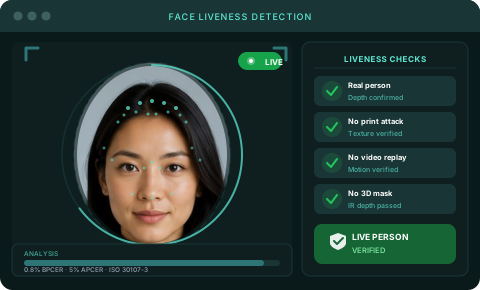
Catch presentation attacks before they reach your onboarding flow. Passive liveness identifies print, replay, and 3D mask attacks from a single frame — no challenge, no instructions, no added drop-off.
- BPCER 0.8% at APCER 5%
- ~150ms median latency
- Print, replay, and 3D mask detection
- ISO 30107-3 compliant
Availability
Face liveness is in private beta
The model is trained and benchmarked, but we are not publishing a public demo for this one — an open liveness endpoint is an open target for people who want to probe it. Early access runs through design partners instead.
No public demo yet
We run early access as a design-partner programme — you get API keys and we get feedback from a real integration before general release.
How it works
How passive liveness works
Face comparison asks whether two faces match. Liveness asks something prior to that: is this a real person, right now, in front of the camera? A system that only compares will happily match a photograph of the right person.
- 1
A single frame is captured
No challenge, no instructions, no head-turning. The user takes an ordinary selfie, which is the whole point — every instruction you add costs you completions.
- 2
Texture and reflection are analysed
Real skin has micro-texture that print and screen reproduction flatten out. Screens emit light uniformly; skin produces specular highlights that behave differently across the face.
- 3
Depth is estimated from the single image
Monocular depth cues separate a genuinely three-dimensional face from a flat surface held up to the camera, without needing a depth sensor or a second frame.
- 4
A score and verdict come back
You get a liveness score from 0 to 1, a live/spoof verdict at your chosen operating point, and where the signal is clear enough, a classification of the spoof type.
Threat model
What it defends against
ISO/IEC 30107-3 groups presentation attacks into families. The fourth row below is not a presentation attack at all — and that distinction matters more than it sounds.
| Attack | How it works | Detection signal |
|---|---|---|
| Print attack | A printed photograph, sometimes cut out around the eyes or bent to fake curvature. | Absent skin micro-texture, paper grain, flat depth response. |
| Replay attack | A photo or video played back on a phone or tablet screen. | Uniform screen emission, moiré patterning, display bezel and refresh artefacts. |
| 3D mask | A silicone, resin, or paper-craft mask worn over the face. | Material reflectance unlike skin, rigid regions where a face would deform. |
| Digital injection | Synthetic video fed in upstream of the camera, bypassing the sensor entirely. | Not visible in-frame — needs device attestation and capture-path integrity checks. |
Digital injection is the honest gap in every frame-analysis liveness model, ours included. If the attacker never presents anything to the camera, there is nothing in the image to catch. That defence lives in device attestation and capture-path integrity — covered in the liveness technical deep dive.
Measurement
Reading liveness accuracy claims
A vendor quoting one liveness number is telling you almost nothing. The two error rates trade against each other, so only a pair is meaningful.
APCER
Attack Presentation Classification Error Rate
Spoofs that got through. Lowering it means tightening the threshold, which rejects more real users.
BPCER
Bona Fide Presentation Classification Error Rate
Genuine users wrongly rejected. Every point here is abandoned onboarding, and it is the cost nobody quotes.
BPCER @ APCER
The pair that actually means something
Our 0.8% BPCER is quoted at 5% APCER. Any single-number liveness claim is hiding one half of this.
Use cases
Where liveness belongs
KYC onboarding
Confirm the selfie is a real person before comparing it to the ID portrait, so a good spoof cannot produce a confident approval.
Step-up authentication
Gate high-value transactions and password resets behind a liveness check rather than an SMS code that can be intercepted.
Remote proctoring
Verify a genuine person is present during an exam or assessment, not a looped recording.
Account recovery
Re-establish identity when a user has lost their device, where a stolen photo is the most obvious attack.
In every one of these, liveness runs before face comparison. Reversing the order produces confident approvals of well-made spoofs.
FAQ
Liveness detection FAQ
- What is face liveness detection?
- Liveness detection determines whether the face in front of the camera belongs to a real person physically present at capture, rather than a photo, a video replay, or a mask. It answers a different question from face comparison: comparison asks whether two faces match, liveness asks whether the face is genuine in the first place.
- What is the difference between active and passive liveness?
- Active liveness asks the user to perform a challenge — blink, turn your head, smile. Passive liveness reaches a verdict from a single unguided capture with no instructions. Passive avoids the 15–30% higher drop-off that challenge flows introduce and cannot be defeated by replaying a recorded challenge response, which is why it has become the default for high-volume consumer onboarding.
- Which attacks does it detect?
- The three presentation attack families defined in ISO/IEC 30107-3: printed photographs including cut-outs and bent prints, screen replay of a photo or video, and 3D artefacts such as silicone masks or resin heads. Detection relies on cues a genuine face has and an artefact does not — skin micro-texture, specular reflection behaviour, and monocular depth cues.
- What do APCER and BPCER mean?
- APCER is the Attack Presentation Classification Error Rate — the share of spoof attempts wrongly accepted as genuine. BPCER is the Bona Fide Presentation Classification Error Rate — the share of real users wrongly rejected. They trade off against each other, so a liveness figure is only meaningful when quoted as one at a fixed value of the other.
- Does liveness detection stop deepfakes?
- Not on its own. A liveness model analyses the frame it receives, so an attacker who injects synthetic video upstream of the camera — via a virtual camera driver or a tampered client — never presents anything to the sensor at all. Defending against injection needs signals outside the frame: device attestation, capture SDK integrity checks, and session binding.
- Does it need a special SDK or camera?
- No. The API takes an ordinary JPEG or PNG from any standard camera and returns a liveness score, a live/spoof verdict, and where detectable a spoof type. A capture SDK adds value for injection resistance and frame quality gating, but it is not required to get a liveness decision.
- Where does liveness belong in a KYC flow?
- Before face comparison. Matching a high-quality spoof against a genuine ID document produces a confident, completely wrong approval. Establish that the selfie is real first, then compare it to the document portrait.
- When will the API be available?
- Face liveness is in private beta with design partners. Early access includes API keys and direct engineering support in exchange for integration feedback. Contact us to be considered for the programme.
Related reading
Go deeper
What is face liveness detection?
The fundamentals — what liveness is, why it exists, and where it sits in a KYC flow.
ReadLiveness detection: technical deep dive
Attack taxonomy, ISO/IEC 30107-3 conformance, and the deepfake injection problem in detail.
ReadAvailable today: face comparison, face detection, and face blur.
Ready to ship identity verification?
Talk to our engineering team about your use case. We'll get you up and running in under a day.
SOC 2 Type II · GDPR Ready · ISO 27001